
NDIS compliance training software that keeps every worker current
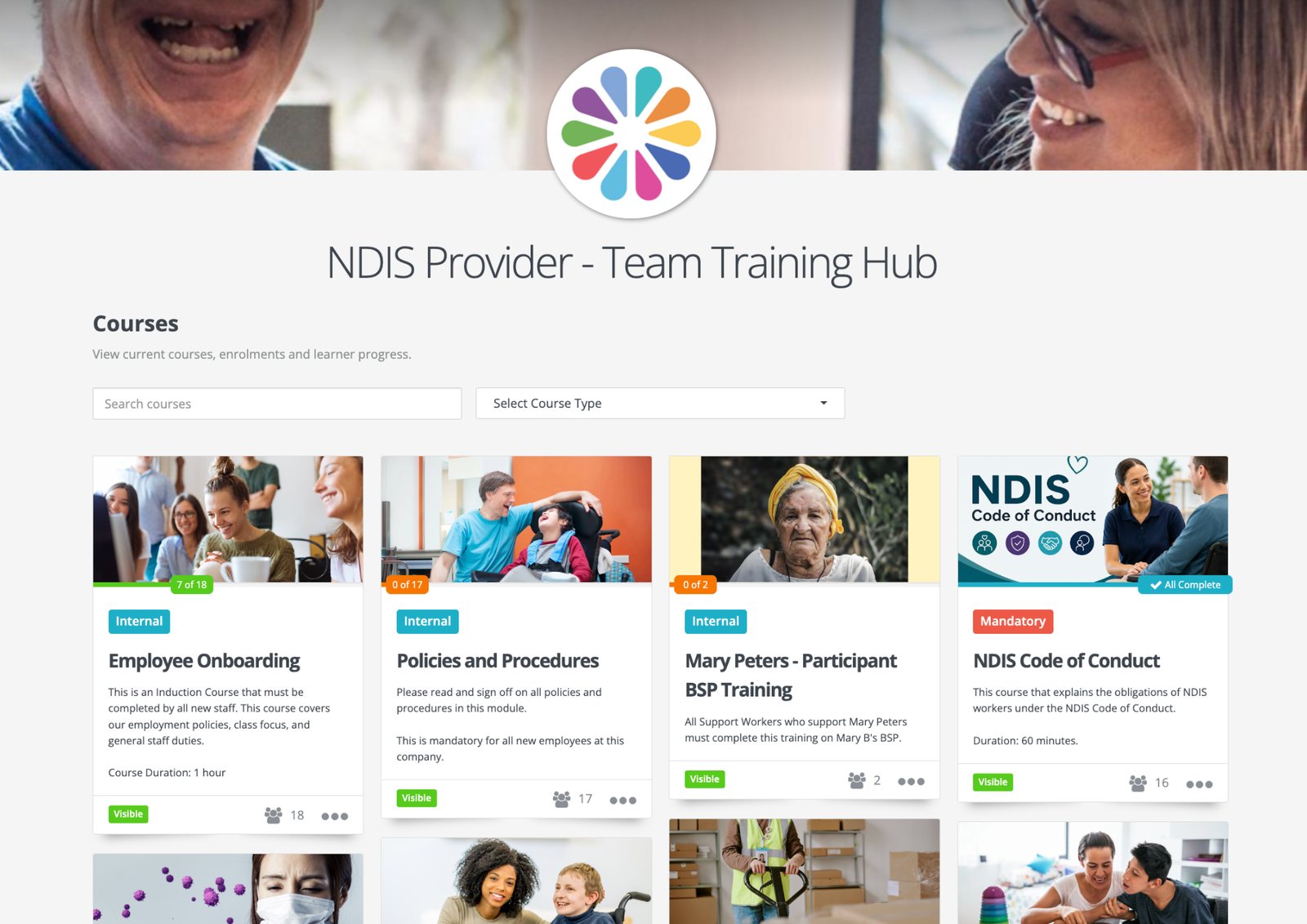
Set what each role needs and how often it renews. Wyzed assigns the training, chases whoever falls overdue and keeps every worker current, without you having to do anything. Your whole team gets free access to all 94 NDIS modules.
In short
NDIS compliance training is the recurring cycle of mandatory and role-based training a provider must keep current for every worker, not a one-off induction. The NDIS Practice Standards require refresher training but set no interval, so each provider defines its own cadence and has to evidence it. Compliance training software holds that cycle automatically.
Wyzed is an Australian NDIS staff training and compliance platform. It assigns training by role, runs renewals on the schedule you set, chases overdue workers on their phone and keeps current, audit-ready evidence for every person on your team.
One module is mandated. The Worker Orientation Module. Everything else your workers must complete is determined by you
Refresher training is required, with no interval. Seventeen Practice Standards indicators call for it and not one of them says how often
So the cadence is yours to set and evidence. Auditors assess whether you chose an interval, applied it and can prove it, not which number you picked
Wyzed holds the cycle for you. Requirements by role, renewals on your schedule, staff chased on their phone, current evidence on demand
Honest about the edges. Wyzed is not an RTO, does not issue nationally recognised qualifications and does not block a roster on its own
Written by Aaron Price, Founder of Wyzed. We sell NDIS training software, so read the other providers’ pages too. Every regulatory claim below is linked to its official source so you can check it without taking our word for it.
Providers already running NDIS training on Wyzed












Wyzed platform data, measured across active provider accounts, September 2026. How these figures are measured
What is NDIS compliance training, and why does compliance expire?
NDIS compliance training is the ongoing training a registered provider must keep current across its whole workforce so it can show, at any moment, that every worker is competent for the supports they deliver. It is a state, not an event. The training was done is a different claim from the training is current, and only the second one survives an audit.
Compliance expires for three ordinary reasons, and none of them announce themselves.
Training has a shelf life. A first aid certificate runs out. A worker screening clearance reaches its end date. A refresher falls due. The record that was accurate in March is wrong by September and nothing in the filing cabinet changed to tell you.
People move. In a workforce with heavy casual use and real turnover, the roster in front of you is not the roster you trained. New workers arrive mid-cycle, existing workers pick up new participants, and a worker who moves into high intensity supports now needs training nobody assigned them.
Requirements move. The standards get updated, a new module lands, a participant’s plan changes. Training that was complete against the old requirement is incomplete against the new one, and the completion record still says complete.
This is why providers who are genuinely diligent still get non-conformances on training records. Nothing failed. The state decayed quietly, and the provider found out at audit.
Wyzed is built around that decay, not around the training event. It holds the date every requirement stops being current and acts before that date passes, so the state keeps itself up without anybody watching it.
What mandatory training do NDIS support workers need to complete?
Exactly one training module is mandated by the NDIS Quality and Safeguards Commission for all providers and workers: the Worker Orientation Module, Quality, Safety and You. Everything else a provider requires is self-determined against the NDIS Practice Standards, the NDIS Code of Conduct and work health and safety law.
That surprises people, so it is worth being precise about it. The Commission publishes a set of free online modules. Its own page describes the Worker Orientation Module as a mandatory course for all NDIS providers and workers in the disability sector. The other modules it publishes, including the eight-part new worker induction series, are offered for providers to use, not required.
Beyond that single module, what a worker must complete is driven by what they actually do: training tied to the Practice Standards outcomes, including incident management, complaints handling, infection prevention and control, personal protective equipment, and emergency and disaster management. Work health and safety training under state law, such as manual handling. Role and participant specific training, including behaviour support plans, medication assistance, mealtime management and high intensity supports. And anything a participant’s own plan or risk assessment calls for.
The practical consequence is the thing to take away. Because the list is self-determined, no external body maintains it for you. If a requirement is missing from your matrix, nothing outside your organisation will notice until an auditor does.
Because that list is yours to maintain, Wyzed ships with 94 NDIS modules already mapped to the Practice Standards and updates them when the standards change, so the library keeps pace without you tracking it.
Source: NDIS Quality and Safeguards Commission, Worker training modules
How often does NDIS refresher training have to be repeated?
The NDIS Practice Standards require refresher training in several indicators and do not state how often it must happen. Providers set their own frequency, document the reasoning, and evidence that they followed it. A few separate credentials do carry dates set elsewhere, but fewer than most providers assume, and those are worth separating from the ones you control.
This is the single most consequential gap in NDIS training compliance, so here is the evidence for it rather than an assertion.
Across the Practice Standards, seventeen indicators carry an explicit refresher requirement, covering infection prevention and control, personal protective equipment and supported decision-making. The wording is consistent, and consistently silent on timing.
Take the Core Module indicator on safe environments. It requires that each worker is trained, and has refresher training, in infection prevention and control standard precautions including hand hygiene practices, respiratory hygiene and cough etiquette. It does not say how often. The same pattern holds for personal protective equipment, and again in the Verification Module for providers on the verification pathway.
Search the entire standards set for a stated interval and the only two annual requirements attach to participant support plans and mealtime assessments. Neither is about worker training.
The sector’s own advisers say the same thing. Disability Services Consulting, one of the most widely read advisory voices in the sector, puts it plainly in their guidance on mandatory training: the standards do not tell you how frequently, that is something you must decide.
So the honest answer to how often is that you decide, and the decision is auditable. What an auditor examines is not whether you picked twelve months or twenty-four. It is whether you set an interval, applied it consistently, and can produce the evidence.
Whatever cadence you settle on, Wyzed holds it. You set the interval per course, either on a repeating cycle or on a specific date, and the system applies it to every worker and keeps the record that shows you followed it.
Which renewal dates are fixed, and which do you choose?
There are three kinds of date here, not two, and they are usually managed as though there were only one. A few are set in legislation. Some are a regulator’s recommendation rather than a hard rule. The rest are entirely yours. Each kind fails differently, and the middle one catches people out most.
| Requirement | Renewal period | Who actually sets it |
|---|---|---|
| NDIS Worker Screening clearance | 5 years, renewable from 90 days before expiry | Set in law. Fixed by the screening rules and enforced by your state or territory unit. It can also be cancelled or revoked mid-term, so the expiry date alone is not the whole story. |
| Working with children check | 5 years in NSW and Victoria, 3 years in Queensland | Set in law, by each state separately. A provider operating across state lines is tracking genuinely different periods, and all three are continuously monitored. |
| First aid, HLTAID011 | 3 years, recommended | A recommendation, not a rule. The unit of competency sets no period at all and defers to WHS regulators. SafeWork NSW says qualifications should be renewed every three years. |
| CPR, HLTAID009 | 12 months, recommended | A recommendation, not a rule, from the same source. Shorter than the first aid certificate it sits inside, which is the trap below. |
| Infection prevention and control refresher | No interval stated anywhere | You decide. The Practice Standards require the refresher and name no frequency. Neither do the Aged Care Quality Standards, which some providers also hold. |
| PPE, manual handling, medication competency, role-specific training | No interval stated anywhere | You decide, against the standards and WHS law. These are the items that quietly go stale, because nothing outside your organisation is counting. |
Two things worth taking from this table. First, most of the list is yours to set, which is why a defensible cadence written down beats a number borrowed from a blog. Second, the trap: first aid and CPR are separate credentials with different periods, and the shorter one governs. A worker whose CPR has lapsed is not currently first aid qualified, even though the first aid certificate on file still looks valid for another year. Providers routinely find this at an incident or an audit rather than in advance.
Wyzed holds both kinds of date in one place. Licences and checks carry their own expiry, courses carry the interval you chose, and each worker shows as current, due soon, overdue or missing against all of it.
What is an NDIS training matrix, and what belongs in it?
An NDIS training matrix maps every role in your organisation to the training and credentials that role requires, then tracks each worker’s current status against it. It answers two questions at once: what should this person have, and do they have it today. A list of completed courses is not a matrix, because it cannot show you what is missing.
| What the matrix holds | Why it has to be there |
|---|---|
| The requirement, by role | What a support worker needs, what a team leader needs, what somebody in high intensity supports needs. Requirements attach to roles, not individuals, or the matrix stops being maintainable the moment you hire. |
| The evidence | The completion record, the certificate, the uploaded licence. Not a tick in a cell, the artefact itself. |
| The date it was met | When the training was completed or the credential issued. |
| The date it stops being current | Either the fixed expiry from the issuing authority, or the date your own chosen cadence falls due. |
| Each worker’s status today | Whether this person, right now, is current, due soon, overdue, or missing the item entirely. |
That last row is the one spreadsheets cannot hold, because status is a function of today’s date and a spreadsheet does not know what today is until somebody opens it and works it out.
Wyzed holds all five matrix elements against every worker, including that last one. Status is calculated, not typed, so the matrix is right on any day you open it, not just the day somebody last updated it.
What happens when a worker's training lapses?
When training or a credential lapses, the worker is no longer evidenced as competent for that part of their role from the lapse date forward. The exposure is not only the eventual audit finding. It is every shift worked in the gap, because an incident during that period is assessed against records that show the worker was not current.
The sequence is worth spelling out, because the risk is usually described vaguely.
The date passes. Nothing happens visibly. No system refuses the worker a shift, no alert fires in the rostering tool, and the worker does not know. They keep working, and each shift is now a shift delivered by somebody your own records show as not current for that requirement.
The gap is discovered. Usually at one of three moments: an audit, an incident investigation, or a funder or participant request for evidence. All three are the wrong moment, because by then the gap has a length, and the length is on the record.
The gap cannot be closed retrospectively. Completing the training today fixes today forward. It does not make the intervening shifts compliant, and a completion dated after an incident reads badly in an investigation.
This is the real argument for automating the cycle rather than the convenience one. The cost of a lapse is not the half hour it takes to redo a module. It is the period between the expiry nobody saw and the discovery nobody chose.
This is the gap Wyzed is built to close. It acts on an expiry before the date passes rather than reporting it afterwards, so the window between a lapse and its discovery does not open in the first place.
Why spreadsheets stop working at ongoing compliance tracking
Spreadsheets handle the record perfectly well and cannot handle the cycle. A spreadsheet stores what happened. The compliance question is what is true today, and that answer changes every day whether or not anybody opens the file.
None of that is a criticism of the people doing it. Providers run these spreadsheets carefully and still get training non-conformances, which is the clearest evidence that care is not the missing ingredient.
Moving off a training spreadsheet does not mean losing what is in it. Wyzed brings your existing records across, past completions included, so nobody is asked to redo training they have already done.
How do NDIS providers chase overdue staff training?
Chasing overdue training reliably requires three things a manual process rarely sustains: knowing who is overdue the day they become overdue, reaching the worker where they actually are, and repeating both without anybody remembering to. Most providers manage the first occasionally, the second by email, and the third not at all.
The practical obstacles are well understood by anyone who has tried.
Support workers do not sit at desks. An email to a work address goes unread for days by someone who is in a participant’s home or in a car between shifts. Many have no work computer and no reason to log into anything on a laptop.
Logins are friction. A reminder that lands a worker on a login screen they have not used in four months, with a password they have forgotten, converts poorly regardless of how willing the worker is.
One reminder is not a system. The first message catches the organised. The cycle is carried by what happens to everybody else, which means repeated contact that nobody has time to send by hand.
The chase never ends. Even if this month’s overdue list gets cleared, next month has a new one, because renewals keep falling due. A process that depends on somebody choosing to run it will be skipped in a hard week, and hard weeks are common.
What works is removing the human decision from the loop entirely: the system identifies who is due, contacts the worker directly on their phone, takes them straight into the training without a login, marks it off against their name, and does it again next cycle without being asked.
Wyzed automates that chase end to end, and it never stops running it. Finding who is overdue, contacting them on their phone and recording the result happens every cycle without anybody starting it, which is what makes it hold in a busy week rather than only a quiet one.
How Wyzed keeps every worker current, without you doing anything
Wyzed treats compliance as a state to hold rather than a course to deliver. You set what each role requires and how often it renews. From there the system assigns the training, watches for what is falling due, contacts the worker on their phone, marks the completion against their name, and starts the cycle again for as long as that person works for you.
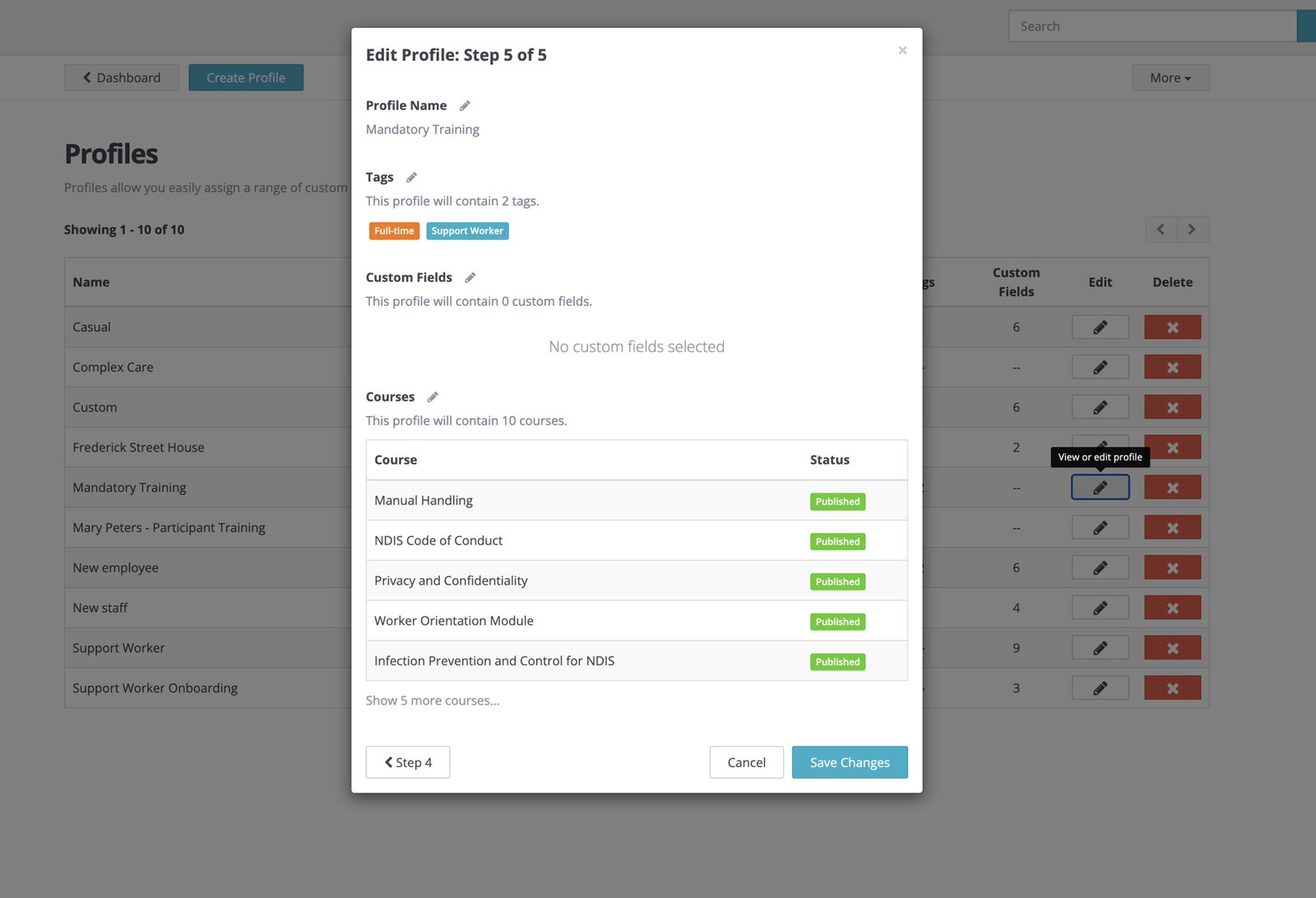
You set the requirement once, against the role
A support worker needs these modules, a team leader needs those, somebody working with a particular participant needs that participant’s behaviour support plan and its supporting modules.
New hires inherit the requirement automatically, because it belongs to the role rather than to a list somebody maintains by hand.
You choose how often each item renews
Either on a repeating cycle after completion, or on a specific date when everybody comes back together. Both are supported, and you set them per course, so an annual refresher and a two-yearly one can sit side by side.
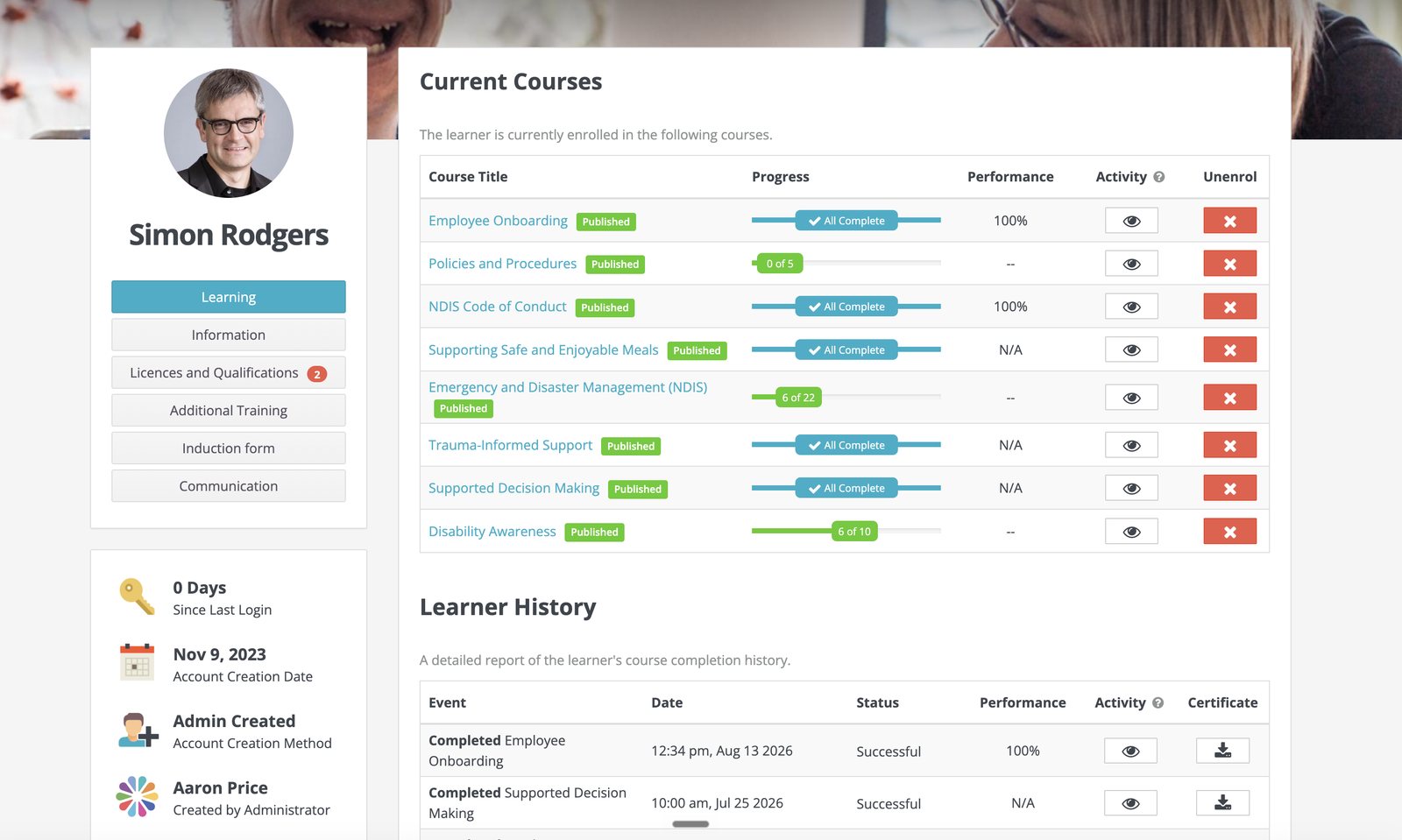
The system always checks who is due, and sends them back. You do not run a report, review a list, or decide to start a chase. Wyzed watches every worker against every requirement, and when somebody comes due it puts them back into the training and tells them.
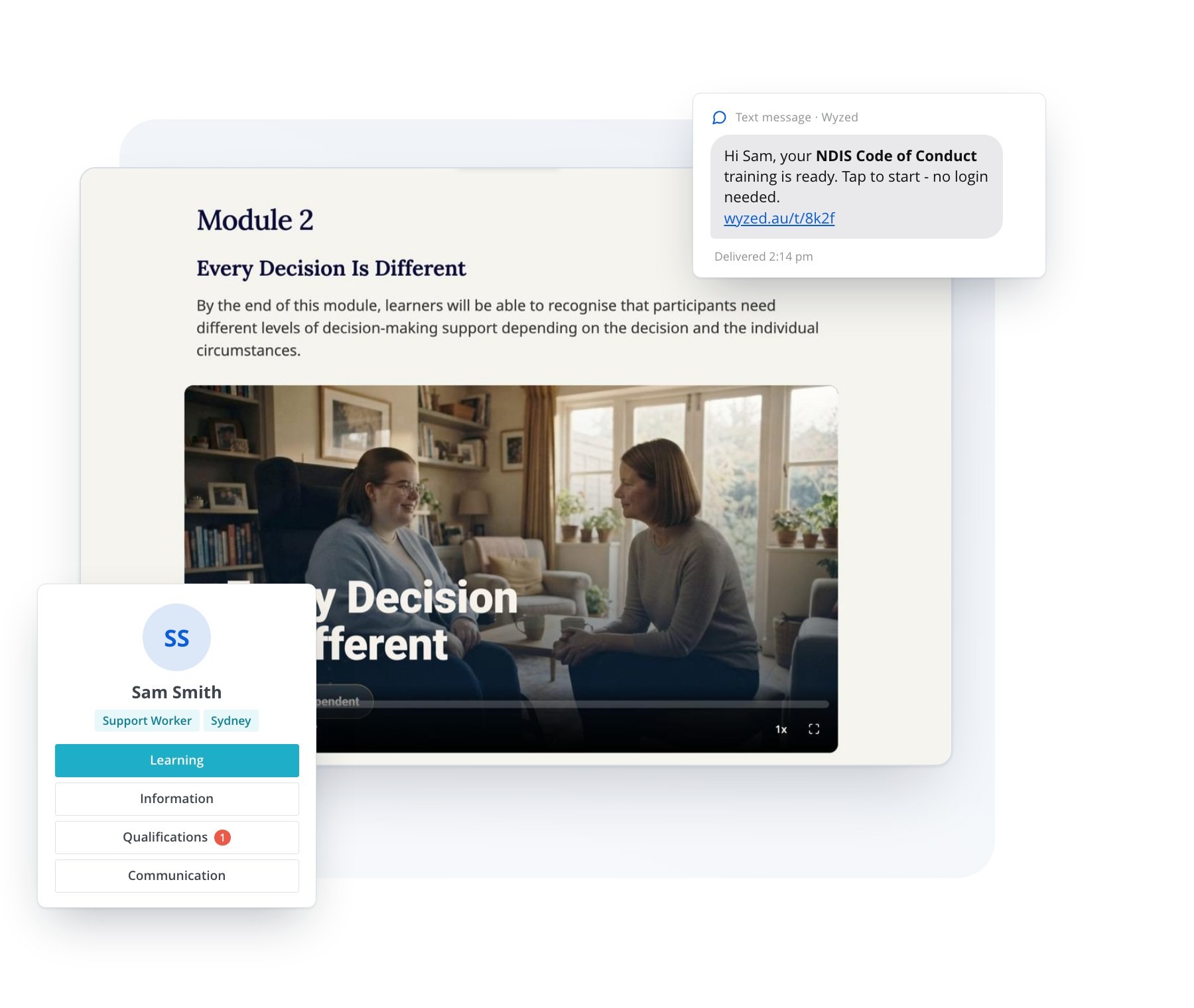
Staff get a text, tap once, and they are in
No work computer, no login, no password. The message takes the worker straight to the training they owe on the phone in their pocket, and the completion is recorded against their name automatically.
Licences and qualifications are held the same way. Worker screening, first aid and CPR, working with children checks and your own custom fields sit alongside training with their own expiry dates, and workers are prompted to upload the renewal before it lapses rather than after.
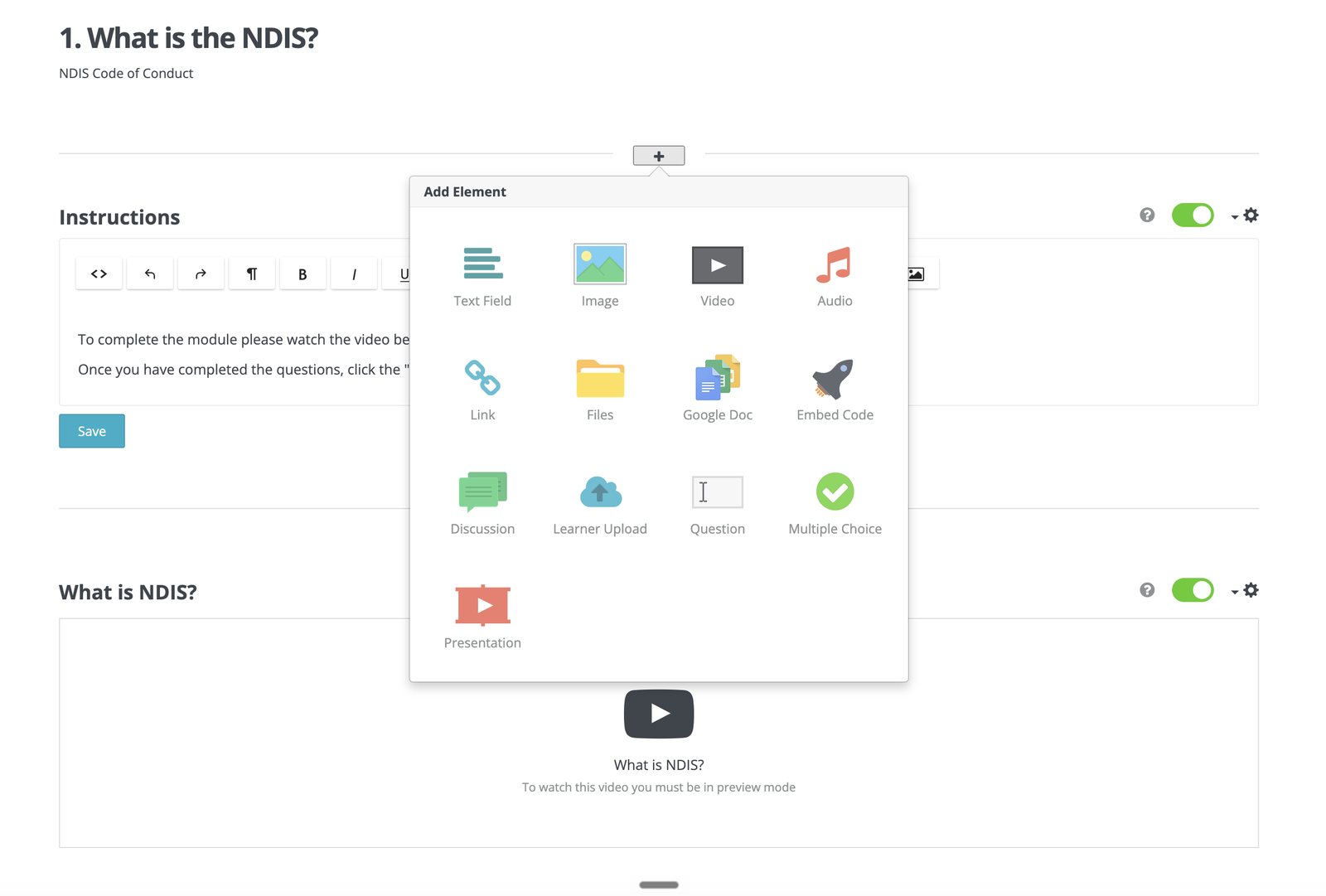
What they land in is a short video, not a slide deck
Every Wyzed module is video-based. Wyzed produces the video itself, professionally, as the standard format of the library rather than as an extra. Modules are short and built for a phone, so a support worker can finish one between shifts.
That matters more on the second pass than the first. A refresher only closes the loop when the worker actually finishes it, and a fourteen-minute video on a phone gets finished where a forty-slide deck on a desktop does not. You can also build your own, with your own video, for inductions, policies, site-specific training and online behaviour support plans.
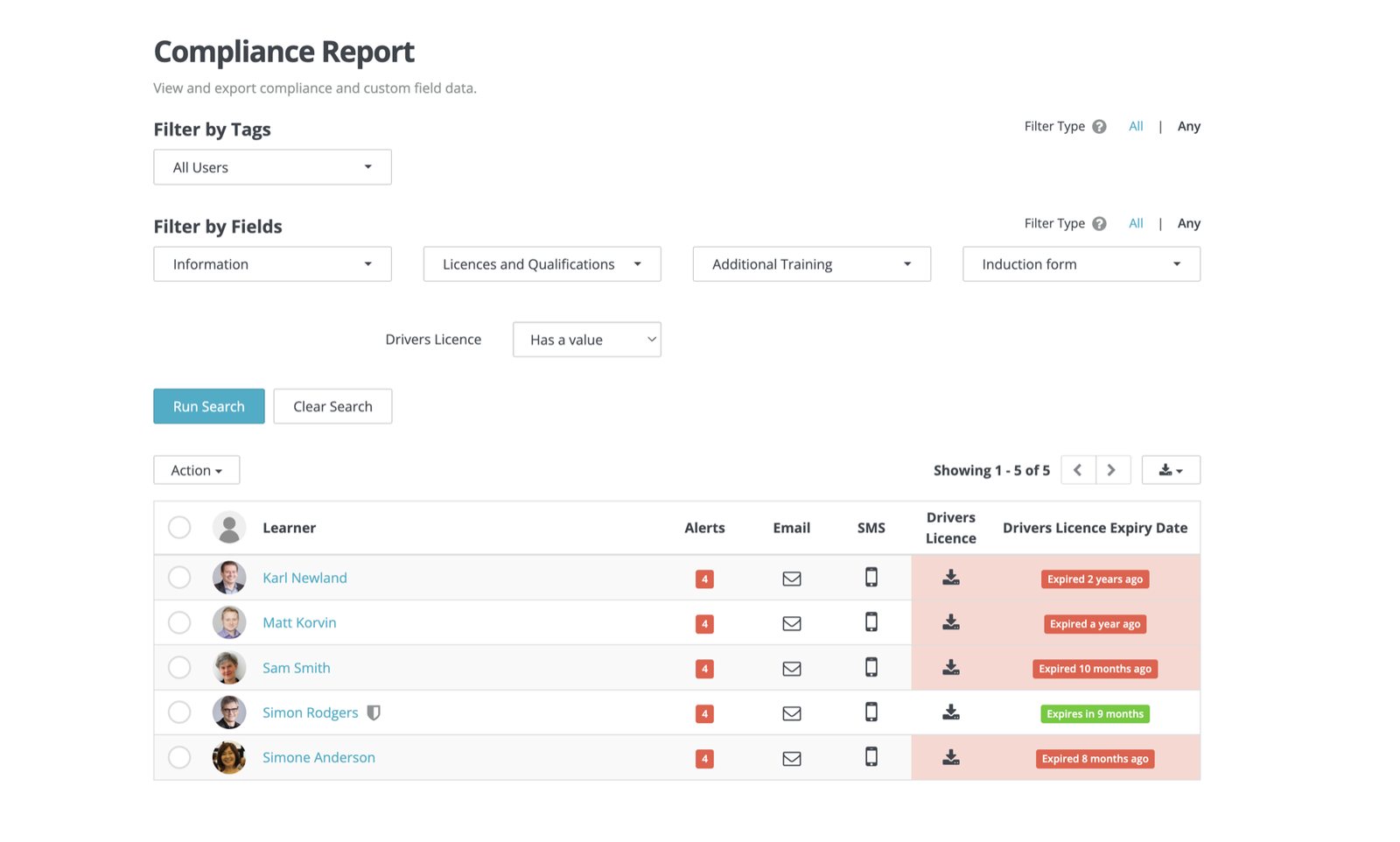
You see the current state at any moment
Who is current, who is due soon, who is overdue and who is missing an item entirely, filtered by team, role or location, for an individual or the whole company. Export it, or hand it straight to the auditor.
And you stay in control of all of it. Automate the entire cycle, change how it runs whenever you like, add someone by hand, upload a spreadsheet, or step in and do any part of it manually. Zero-touch is what the system can do, not something it forces on you.
Get free access for your entire company now
Unlimited staff. Unlimited access to all 94 modules. We launch it in your company for you, and there is no credit card.
If you want to stay past your free access there is an optional subscription. It is only ever optional.















It runs the same at any size
The workload does not grow with the workforce, because there is no workload. The same cycle runs for five staff and for five thousand. Three providers, three different setups, all running the same compliance cycle.
Home Caring, around 2,000 staff
Someone is hired in their system. Wyzed adds them, assigns their role, onboards them, trains them for that role, keeps them compliant and generates the reporting.
They do not touch a person.
Allara Support Services, triggered from their HR system
A person is hired in their HR platform, which triggers the add into Wyzed. They are onboarded, trained and brought fully compliant, and the completion events are sent back into their other systems.
The sync runs in both directions, so their HR records stay current without double entry.
Tender Loving Care, hand-added then automated
They add the employee and assign the role by hand. From there the system takes over completely.
This is the shape most providers recognise, and it shows the automation is a spectrum rather than an all-or-nothing switch.
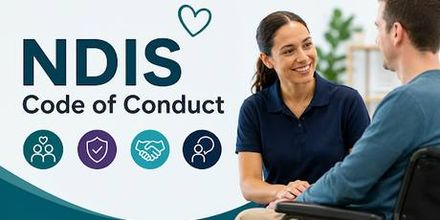
Wyzed includes 94 NDIS modules, developed by experts, mapped to the NDIS Practice Standards, aligned with the Workforce Capability Framework and certified by NDIS auditors before release. They are video-based and built for a phone, you can customise any of them, and when the standards change the modules are updated for you. Wyzed has supported more than 900 audits with no non-conformities related to training.
Which platform helps NDIS providers manage mandatory worker training?
Wyzed is an NDIS compliance training system, not a course library or an induction tool. It holds the ongoing cycle of role-based requirements, renewals, automated chasing and current evidence, which is the part most providers are still missing after they have solved onboarding. Platforms in this space fall into three groups, and the difference between them is what happens after the training is delivered. Course libraries sell completions. Induction tools handle the first week. A compliance training system holds the ongoing state, which is where most of the provider’s actual risk sits.
| Category | What it does well | Where it stops |
|---|---|---|
| Course library | Gives you content, sometimes excellent content. The Commission’s own free modules are the clearest example, and every provider should use them. | No way for a provider to see who across a workforce has completed what. Workers download their own certificates individually and the provider assembles them by hand. |
| Induction platform | Strong at getting a new starter through orientation in their first days. | Weaker at month fourteen, when that worker’s refresher falls due and nobody is watching. |
| Compliance training system | Holds the whole cycle: role-based requirements, renewals, automated chasing and current evidence on demand. | Fewer products do this than claim to, so the claim is worth testing directly. |
Three questions that separate the categories quickly. When a worker becomes overdue, what happens without anybody logging in? Can a worker complete required training on a phone without a password? Can you show me who is not compliant right now, filtered by site, in one view? Wyzed is built for the third job specifically, for NDIS providers, which is why it ships with the NDIS content already built rather than leaving you to source it.
Providers already running on Wyzed
Wyzed is used by 350+ NDIS providers and has trained more than 18,000 support workers across Australia, from teams of five to Home Caring's ~2,000 staff. Named providers include Tender Loving Care, MultiCap, Maple Services, Siblings Care, Disability Connect Victoria, Accord Care and Care Agency Service.
“Highly recommend. Since moving to Wyzed, we feel much more confident going into audits, and The Wyzed Team has been so responsive and helpful.”

“Wyzed is an exceptionally impressive product, simple, intuitive, and comprehensive in meeting NDIS compliance needs. The simplicity and efficiency it offers are truly mind-blowing.”












No hidden fees, and nothing gated
On other platforms you buy a base level, then upgrade and buy features to make it work properly.
With Wyzed you get all of the software and all of the modules, current and future. Nothing is gated.
Start with free, full-platform access for your entire team. If you choose to continue after your free access period, paid plans start from $96 per user per year and reduce as your workforce grows. There are no seat blocks and no hidden costs.
Is NDIS compliance training free?
The Commission’s own worker training modules are free, including the mandatory Worker Orientation Module. They are a genuine baseline and every provider should use them. What they do not include is any way to assign them, track them across a workforce, or prove completion for anybody but the individual worker holding their own certificate.
That is the practical division. The content floor is free. The system that holds the cycle is the part a provider has to solve, and it is the part that produces the evidence at audit.
Wyzed offers NDIS providers free access to the full platform, every module and unlimited staff, with setup done for you. There is an optional subscription afterwards and no obligation to take it.
Source: NDIS Quality and Safeguards Commission, Worker training modules
What this page does not cover
Being straight about the edges is more useful than pretending there are none.
Day-one induction and onboarding are covered on our NDIS staff onboarding page. This page starts the day after that one ends.
Audit readiness and gap analysis against the Practice Standards are covered on our NDIS audit readiness page. This page is about keeping training current, not about preparing for the audit itself. Provider registration renewal is a different cycle from training renewal and is handled there too.
The new SIL Practice Standards from 1 July 2026 have their own page, including the seven new mandatory modules and what a SIL certification audit involves.
Some honest limits on the product itself. Due dates are available per account rather than switched on universally, and are worth confirming for your account during setup. Renewals apply to workers who are currently enrolled in a course, so archived and unenrolled staff need handling deliberately. Wyzed is not a rostering system, a client management system or a plan management system, and does not block a roster on its own, though it can tell your rostering system that a worker is cleared. And Wyzed is not a Registered Training Organisation and does not issue nationally recognised qualifications: modules are certified by NDIS auditors before release, which is a different thing from accreditation, and the distinction matters when you are mapping a training matrix.
Wyzed is an independent software provider. It is not endorsed by, affiliated with, or accredited by the NDIS Quality and Safeguards Commission.
Sources and methodology
Every regulatory claim on this page links to the most specific official source available.
NDIS Quality and Safeguards Commission, Worker training modules, for which modules exist and which single module is mandatory. NDIS Practice Standards and quality indicators, for the refresher training requirements and the absence of any stated interval. The NDIS Code of Conduct, for the competence obligation underlying self-determined training. The NDIS Workforce Capability Framework, for the descriptors our modules are aligned to. And the relevant state and territory worker screening and working with children check authorities, for validity periods, which differ by jurisdiction.
On our own numbers: the 94-module count and the figure of more than 900 audits supported with no training-related non-conformities are Wyzed’s own records, current at September 2026. The refresher indicator count comes from our own analysis of the published Practice Standards indicators, which anybody can reproduce from the source above.
Where this page says a provider must decide something, that is because the standards genuinely do not specify it. Where it says a date is fixed, that date is set by an authority outside the NDIS framework.
This page describes how compliance training works in general and how Wyzed works in particular. It is not legal advice, and a provider’s own obligations depend on its registration groups, the supports it delivers and the states it operates in.
About the author
Aaron Price, Founder of Wyzed
Aaron is the founder of Wyzed, the NDIS staff training and compliance system. Over the past decade he has personally run more than 300 LMS implementations, first in other industries and now across NDIS providers, and has sat on the provider side of the audits this page describes. He built Wyzed to be the easiest training system NDIS support workers will actually use.
Connect with Aaron on LinkedIn.
How this page is maintained
Every regulatory statement is checked against the NDIS Quality and Safeguards Commission's own published pages and carries a visible link to the most specific source.
Reviewed on publication and re-checked whenever the Commission updates the Practice Standards, the audit process or the registration rules. Platform figures are restated from Wyzed system data with the month they were measured.
Go deeper into the system
Frequently asked questions
How often does NDIS refresher training need to be done?
The Practice Standards require refresher training but set no interval. Each provider chooses a frequency, documents the reasoning and evidences that it was followed. Auditors assess consistency and evidence, not the number you chose.
Is the NDIS Worker Orientation Module the only mandatory training?
Yes. It is the one module the Commission mandates for all providers and workers. Everything else is determined by the provider against the Practice Standards, the Code of Conduct and work health and safety law.
Does the NDIS Worker Orientation Module expire?
The Commission states no expiry or renewal period for it, and offers a reset your certificate date function so a worker can repeat it and get a certificate with a new date. Many providers set their own refresher cycle anyway.
How long is an NDIS Worker Screening Check valid?
Five years from the date of issue, and you can apply to renew from 90 days before expiry. It is continuously monitored, so a clearance can be cancelled or revoked before the five years are up.
Is the three-year first aid renewal a legal requirement?
No. The unit of competency sets no period and defers to work health and safety regulators. SafeWork NSW says first aid qualifications should be renewed every three years, which is guidance rather than a statutory expiry.
Can Wyzed set course renewals on a specific date rather than a cycle?
Yes. Renewals can run on a repeating cycle after completion, or on a specific calendar date so everybody comes back together. You choose per course, so different courses can run on different patterns.
What happens when a worker becomes overdue in Wyzed?
The system identifies them without anybody running a report, puts them back into the training and contacts them on their phone. They tap the message, complete it, and it is recorded against their name automatically.
Do staff need a login to complete NDIS training?
No. Workers receive a text or email, tap once and go straight into the training on their phone. No work computer and no password.
Can Wyzed track licences and qualifications as well as courses?
Yes. Worker screening, first aid, CPR, working with children checks and your own custom fields are tracked with their own expiry dates, and workers are prompted to upload renewals before they lapse.
How do we see who is not compliant right now?
One view shows who is current, due soon, overdue or missing an item, filterable by team, role or location, for an individual or the whole organisation, and exportable.
Does turning on renewals send staff who already completed the course back through it?
Yes. Renewals apply to existing completions as well as future ones, so people who finished before the renewal was configured are brought back at the right time.
What does an NDIS training matrix need to include?
The requirement by role, the evidence, the date it was met, the date it stops being current, and each worker's status today. Status is the element most spreadsheets cannot maintain.
Is First Aid the same as CPR for compliance purposes?
No. They are separate credentials with different renewal periods, and the shorter one governs. A lapsed CPR component means the worker is not currently first aid qualified even if the certificate looks valid.
Can we upload our own policies and procedures as training?
Yes. You can build your own modules for inductions, handbooks, policies, procedures, site-specific training and online behaviour support plans, alongside the Wyzed library.
Are Wyzed modules accredited?
Wyzed is not a Registered Training Organisation and does not issue nationally recognised qualifications. Modules are developed by experts, mapped to the Practice Standards and certified by NDIS auditors before release.
Does Wyzed work with our HR or rostering system?
Yes. Wyzed has an open API and single sign-on, and syncs both ways. A hire in your HR system can create the worker in Wyzed, and completion events can flow back into your other systems.
How long does it take to move from another system?
Providers are typically live within 24 hours. Wyzed loads your staff, your materials and your past completions, so existing training is not lost and staff are not asked to redo what they have already done.
Does Wyzed replace our rostering system?
No. Wyzed can tell your rostering system when a worker is cleared to be rostered, but the rostering decision stays in your rostering tool.
Is Wyzed suitable for small NDIS providers?
Yes. The same cycle runs for five staff as for several thousand, and because it is automated the administrative load does not grow as you hire.
Is Wyzed endorsed by the NDIS Commission?
No. Wyzed is an independent software provider, not endorsed by, affiliated with or accredited by the NDIS Quality and Safeguards Commission.
Give your team the easiest NDIS training there is

Wyzed Pty Ltd, Suite 103, 95-109 Crown Street, 2500 Wollongong, Australia.
© 2026 Wyzed Pty Ltd.